Action Alert: Protect Public Access to Kansas Navigable Rivers – Act Now on HB 2495

Action Alert: Protect Public Access to Kansas Navigable Rivers – Act Now on HB 2495

Dear Friends of the Kaw Members,

Kansas House Bill 2495 is currently under consideration by the Kansas Legislature. This bill would grant counties new authority to regulate “activities on or within” navigable rivers, including the Kansas, Arkansas, and Missouri Rivers, and expand criminal trespass to cover these rivers.  In Kansas, this means that these rivers are the only fully public rivers in the state.

What Is HB 2495 and Why Should You Care?
Kansas House Bill 2495 would change how navigable rivers—including the Kansas, Arkansas, and Missouri Rivers—are managed and used by the public.

In simple terms, the bill would:

  • Allow counties to regulate activities “on or within” our three navigable rivers (counties already possess broad authority to protect public health, safety, and welfare, making this bill unnecessary).

and

  • Expand criminal trespass laws to include those three navigable rivers.

That may sound technical, but the impact is very real.

Why This Is a Problem

For generations, Kansans have used these rivers for fishing, hunting, paddling, and camping. These are quiet, low-impact activities that are widely understood to be lawful public uses of navigable rivers – which are public land, owned by the people of Kansas, not individual counties.

HB 2495 could change that by:

  • Letting each county create its own rules for river use.
  • Creating confusion as rivers cross multiple counties, often on opposite sides of the river at the same location.
  • Turning ordinary recreation on public land into a potential criminal offense, even when someone is acting responsibly and following state laws. 

In short, lawful recreation could depend on county decisions, and violations could carry criminal penalties.

Kansas rivers are shared, statewide resources. Laws that affect them should be clear, consistent, and protective of public access.


How You Can Take Action: Submit Written Testimony

Legislators need to hear directly from people who care about Kansas rivers.  HB 2495 is scheduled for a hearing in the House Committee on Local Government on Wednesday, February 4, 2026. Submit your written testimony and tell them about your concerns.

Step 1: Write Your Message
Your testimony does not need to be long or technical. A few paragraphs are enough. You can:

  • Explain how you use Kansas rivers (fishing, paddling, hunting, camping, family outings, etc.)
  • Share why public access matters to you.
  • Ask legislators to oppose HB 2495.

Personal stories are especially effective.

Key Talking Points You Can Include:

  1. HB 2495 would allow counties to regulate activities on rivers, creating inconsistent rules. Point out that the Kansas River has counties on opposite sides of the river along most of its length, adding to more confusion. 
  2. Low-impact recreation like fishing, hunting, camping, and kayaking should remain protected.
  3. Expanding criminal trespass to rivers could criminalize lawful activities.
  4. Counties already possess broad authority to protect public health, safety, and welfare, making this bill unnecessary.
  5. Legislation should maintain consistent, statewide standards and clearly protect lawful river use.
  6. Cities along the Kansas River are developing the riverfront through their respective communities and are relying on the economic development that will come from a fully activated riverfront.  These cities include Manhattan to Topeka to Kansas City, Kansas including Rock Island Bridge. 

Step 2: Submit Your Written Testimony
Written testimony can be submitted to the Kansas House Committee on Local Government by email. Testimony is typically accepted:

Step 3: Consider Oral Testimony
In addition to written testimony, you can give oral testimony either in person at the Kansas Capitol or virtually.  You must contact the Kansas House Committee on Local Government by email to make your request.  Please read this document for guidelines: https://kslegislature.gov/li/b2025_26/committees/misc/ctte_h_loc_govt_1/confereeguidelines.pdf

Step 4: Contact Your Legislator
In addition to committee testimony, you can email your own Representative and ask them to protect public access to navigable rivers. Find your legislator: https://pluralpolicy.com/find-your-legislator/

Step 5: Attend the Hearing or Watch Virtually
The hearing is scheduled as follows:

Committee on Local Government
Wednesday, February 4, 2026
9:00 AM
Room 281-N at the Kansas Capitol

Committee page:  https://kslegislature.gov/li/b2025_26/committees/ctte_h_loc_govt_1/

Committee YouTube page to watch online: https://youtube.com/playlist?list=PLGnUWv2THZAjolcVP2PEKRbQpGMzd3Wkw&si=8p5ko42ISsthz_rU


Why Your Voice Matters

Bills like HB 2495 move quickly—and lawmakers often hear more from government agencies than from everyday river users. Speaking up helps ensure that real-world impacts on recreation and public access are part of the conversation.

The Kansas River belongs to all of us. Let’s make sure the laws reflect that.
Thank you for standing up for public access, recreation, and the health of Kansas rivers.

For the river,
Dawn Buehler
Kansas Riverkeeper

Chasing the Channel- Blog No. 37

Chasing the Channel- Blog No. 37

Closing out year 34 of our work for the Kansas River!

Looking outside my tent at the sunrise on our annual Kaw River Guide weekend in late October.

I am deep in winter planning and administration mode at the moment…but my mind and heart still drift back to a great season of adventure and stewardship of our beloved Kansas River. When we are in the middle of the chaos of a busy season (our spring/summer/fall season), it is sometimes challenging to slow down to appreciate it. I admit often that we sometimes pack too much into a season, but there are so many great opportunities to explore the river and provide outreach opportunities that none of us want to miss it! Case in point, the photo above of a beautiful sunrise from the door of my tent. Our Kansas River is special, but it is still a secret that only a small portion of Kansans fully realize.

We spent the late summer season working on some key projects that included a video about our work with a film crew from our friends at The Nature Conservancy in Kansas.  We are so grateful for the opportunity to share our story and the story of the impact of federal funding opportunities to help with our work.  You can catch the video here: https://youtu.be/r9gmNRD8ewA?si=5GSA9cAyM_bp5C9b

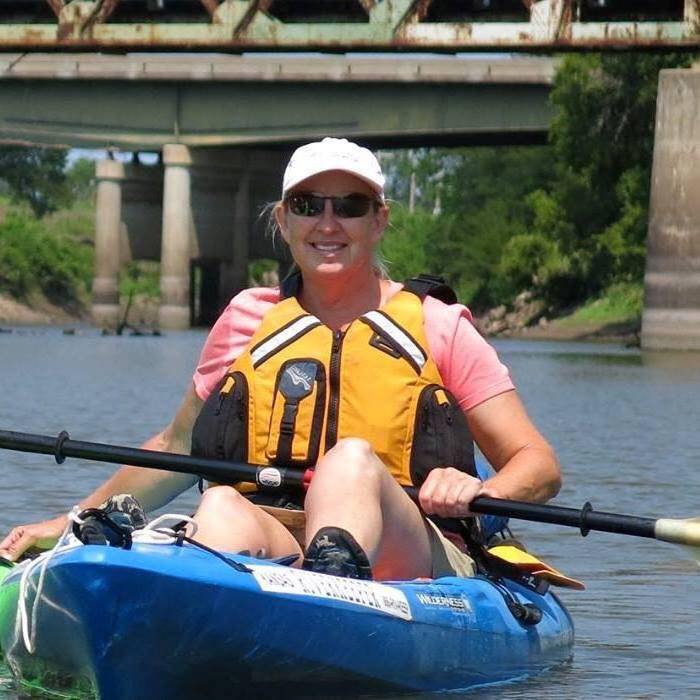
I was lucky to capture this photo of FOK Board Member, Lisa G., on our Kaw River Guide weekend camp and paddle.

In July of this year there was a flood event in the Cedar Creek watershed that caused extensive damage to the Cedar Creek Boat Ramp, which resulted in unsafe conditions for the public.  The Cedar Creek Boat Ramp is now closed.  Please review our Kansas River Access Map: https://kansasriver.org/river-access-map/ to find other access locations along the Kansas River.  We know that everyone loves the short 5-mile stretch between DeSoto and Cedar Creek (including us!), however we do suggest Edwardsville Boat Ramp to Mill Creek Access for a short 2.5-mile trip for paddle sports that is near the KC metro area.  The Mill Creek Access would not be recommended for motorized boats as it is simply a paddle sport access point.

Volunters at our One KC Cleanup in Kansas City, Kansas where they removed 1.5 tons of trash.

We completed our 2nd Annual One KC Cleanup in Kansas City, Kansas.  This has been one our most impactful cleanups to date, serving the lower end of the Kansas River and the people and wildlife that call this home. We had over 200 volunteers and removed over 1.5 tons of trash from the banks of the river.  We are growing this annual cleanup event and we want YOU to be a part of it.  Join us as a volunteer by emailing Kim at kim.bellemere@kansasriver.org or become a sponsor – we need the help – and email Jane at jane.liebert@kansasriver.org.  We hope you can join us.

Joey Shondell, our Youth Outreach Coordinator, working with students in our water quality education program.

Joey completed another season of our Water Quality Education Program.  At the end of the season, Joey had implemented the program in 115 classes to over 2,600 students.  We are proud of this program and the great work that we do to help students understand water quality and how it impacts our rivers. If you want to join us as a volunteer in 2026 with this program, please contact Joey at joey.shondell@kansasriver.org.

In the fall season, the Kansas Water Office and the US Army Corps of Engineers completed the first phase of a research project called Water Injection Dredging. This research project basically involves sending sediment from Tuttle Creek Reservoir down the rivers, while studying the impacts to both the reservoir and the Big Blue River and the Kansas River. 

Monitoring the Kansas River at Wamego.

Sedimentation in reservoirs is an expected process, but the sediment deposition has reduced the surface area of the reservoir and Tuttle Creek is estimated to be filled in with sediment by 75% by the year 2074.  The dam also traps sediment that would otherwise be transported downstream, disrupting natural sediment delivery essential for channel stability and ecological function of the river. This research project was designed to answer many scientific questions and analyze the impacts of this type of project to see if it can be beneficial to both the future water supply for those living downstream, as well as, the ecological function of the downstream rivers. 

I spent 10 days monitoring the turbidity along the Kansas River and found that those results were lower that “normal” high rain events that impact the Kansas River and in line with the data captured by the USGS gaging stations. I spent that time in my kayak or our jon boat testing the water and checking sandbars for sediment deposition. There are many more tests and results that need to be analyzed by the research team so follow along as they complete this work in 2026. 

To learn more about this research project, you can follow along, as well as read up on the technology and studies here: https://www.nwk.usace.army.mil/…/Water-Injection-Dredging/. Additionally, you can read Friends of the Kaw’s policy statement on this study here: https://kansasriver.org/…/FOK-Policy-Statement_-Water…

Our annual cleanup where we went back to the same site and removed another 251 tires.

For our annual big fall cleanup event, we went back to the site between Eudora and DeSoto and removed an additional 251 tires from the Kansas River.  Earlier in 2025, we moved 258, putting the total at 509 for the year at this single location.  This work doesn’t just happen with our four staff members, so we all owe a huge debt of gratitude to our Kaw River Guides and partners that make that project possible.

Kim Bellemere, Director of Programming & Outreach with Alex from Garney Construction.
It takes great partners to make these events happen!

We ended our Kaw Currents Educational Series in October with a program called “Our Watershed Home” that included presentations from Jim Locklear, author of “In the Company of the Kaw” and Matt Unruh, the Assistant Director of the Kansas Water Office.  It was a fascinating evening with so much great educational information that we all left with a little more knowledge about our watershed home.  Big thank you to Jim and Matt for sharing what they know with all of us! 

Jim Locklear and Dawn Buehler at Kaw Currents: Our Watershed Home
Matt Unruh, Asst. Director of the Kansas Water Office and Dawn Buehler at Kaw Currents: Our Watershed Home

My work continues with the Kansas Water Authority and I have been busy with meetings, making policy recommendations, reviewing budgets and working with the legislators to keep water a priority for Kansas.  If you want to help, please contact your legislator ahead of the 2026 session and let them know your thoughts on water policy and funding.  Trust me when I say that they want to hear from you! 

Joey, Kim and Dawn at the Kansas Governor’s Water Conference.

A few last highlights include Beers of the Kaw’s 10 Year Anniversary celebration – thank you to everyone that joined us to toast to the Kansas River.  This is our biggest fundraiser of the year, and because of you, it helps to fund 2026. 

FOK Board of Directors and Staff at Beers of the Kaw. Thank you to our retiring board members Lorraine, Margaret and Sarah for your dedication to the Kansas River. We are forever grateful for your contributions!

This year has been special in many ways, but I can honestly say that getting to interact with all of you is the best part.  We love hearing your stories about the Kansas River – how you grew up on the river, the adventures you have taken, or how you simply admire it from a trail or park bench. We know every single day that we work for the Kansas River that we are doing it for the 950,000 Kansans that rely on it for drinking water and for every single person that enjoys the river that belongs to Kansans. 

Kaw River Guides including Dawn and Kim at the end of season weekend in late October.

May you enjoy the winter season of renewal, may 2026 bring you new adventures on the Kansas River, and may you always have sand in your shoes….

For the river,
Dawn Buehler

Kansas Riverkeeper

Chasing the Channel – Blog No. 36

Chasing the Channel- Blog No. 36 Long summer days make for plenty of opportunities to enjoy the Kansas River! The Kansas River....our beautiful prairie river. I love spring in Kansas, but more directly, I love the month of June.  The longer … [Continue reading]

Friends of the Kaw is Featured in KCUR’s Up From Dust Podcast!

Friends of the Kaw is Featured in KCUR's Up From Dust Podcast! "If you're quiet and you go slowly, you can see otter.  The beavers, sometimes they will stop and freeze in place on the bank and wait until you go on by before they dive … [Continue reading]